
Home Blueprints
SMC / Blueprints

Experience becomes a plan.

For AI that works with people and processes, not around them. Adaptable to your task. Built for practical testing. Designed to be built on.

Explore the applications

SMC concept illustration: people develop a shared plan, connected to a structured workflow and supporting technology by one cyan ribbon.
People decide.Processes connect. Technology supports.AI-generated SMC concept illustration
More than a prompt. More than software.

What is an SMC Blueprint?

A Blueprint is a reusable plan for addressing a task with AI. That task may be developing a target picture, enabling a team or implementing a workflow. The plan connects the approach, responsibilities, suitable tools and quality criteria.

01

A clear scope

The task, desired outcome and explicit limits. Not a promise to automate everything.

02

A usable approach

Steps, roles, methods and suitable technical building blocks, adapted to the organisation.

03

A way to verify quality

Reference sources, test cases, human review and criteria for handover.

04

A foundation to build on

Documentation, open questions and reviewed lessons for the next version.

Selected examples and their current stage

Different tasks. A connected approach.

Open an example to see how people, processes and technology come together.

01Established 8P model · Blueprint in developmentFind direction.

What should your organisation look like when AI plays a useful part?

Use the eight P perspectives to develop a shared target picture. Connect the impact on people, value creation and collaboration, then agree priorities.

The SMC prism brings eight perspectives together into a shared target picture.

The prism, explained: eight perspectives, one target picture.

The prism on our homepage stands for this connected view. The eight P perspectives help surface dependencies and agree where change matters. They are not eight compulsory projects.

  • P1Perspective
  • P2People
  • P3Partners
  • P4Product
  • P5Process
  • P6Production / service delivery
  • P7Personalised customer interaction
  • P8Principles

Your existing strategy framework can also provide the foundation. The Blueprint structures the application; 8P provides the perspectives.

A good fit: When leadership and teams need a shared direction, not another list of AI tools.

How we would work on it together

  1. Describe today’s situation and the ambition across the eight perspectives.
  2. Connect dependencies, trade-offs and priorities with the people concerned.
  3. Record a target picture and agree the first fields of action.
What we need
Your existing strategy, key constraints and the people who can set priorities. An existing framework can replace 8P.
Where this ends
A target picture provides direction. Technical design, investment approval and implementation are separate steps.
Discuss this starting point
People
Leaders and stakeholders contribute their perspectives and own the agreed priorities.
Processes
Document the current situation, target picture, dependencies and next steps together.
Technology
AI supports perspective-taking and elaboration. The target picture guides where technology can help.

The intended result: An agreed target picture, traceable priorities and next steps with clear responsibilities.

Explore the 8P model
02Format Blueprints planned · not yet developedLearn together.

How does experimentation become a capability that stays with the team?

Learn on your own tasks through Promptathons and Agentathons. The planned Blueprints connect preparation, learning tasks, facilitation and transfer into everyday work.
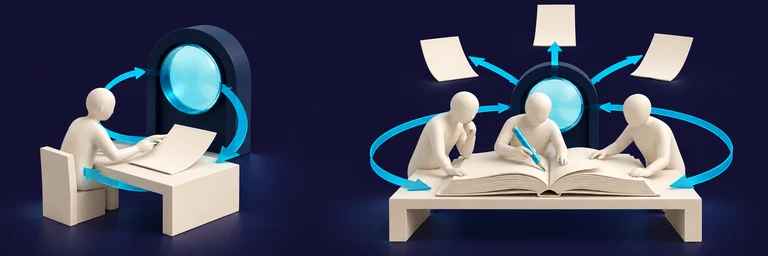
Concept illustration: individuals and teams develop shared ways of working with AI.

A good fit: When people need to practise a useful way of working on their own tasks.

How we would work on it together

  1. Agree the audience, real tasks, learning goal and permitted tools.
  2. Work in guided sprints and review both the results and how they were produced.
  3. Choose what to practise next and who will support transfer.
What we need
Suitable tasks, available AI access and protected or neutral practice material. Agentathons also need an agreed technical learning environment.
Where this ends
The reusable format packages are planned. Bespoke Promptathons can already be discussed. A learning prototype is not production-ready.
Discuss this starting point

Planned format Blueprints, not yet developed. The descriptions below outline the intended approach; they are not fixed curricula.

Promptathon

Teams work on real tasks with AI, compare approaches and review results. The focus is thoughtful prompting and shared learning.

Agentathon

Teams design and test a simple AI assistant or agent-supported workflow. They learn to define tasks, access, boundaries and human approval points.

Promptathons are already part of our training offer. For an Agentathon, we first clarify the learning objective, prerequisites and approved tool environment with you.

People
Clarify the audience, prior knowledge, facilitation and responsibility for follow-through.
Processes
Connect preparation, hands-on work, review and a practical next step.
Technology
Use approved AI tools and suitable sample data. Test agents in a bounded learning environment.

The intended result: Depending on the learning goal: completed tasks, reusable ways of working or an initial agent prototype, with an agreed transfer plan. No automatic production approval.

Discuss learning formats and preparation
03Blueprints in developmentImprove workflows.

Which emails and documents really need your attention?

Classify requests, process documents or prepare replies. With clear rules for when a person takes over.

Concept illustration: documents move through a structured workflow with human review.

A good fit: When recurring messages or documents create a clear bottleneck and people can review the output.

How we would work on it together

  1. Select a bounded process step, representative examples and review criteria.
  2. Test classification, routing or drafts, including ambiguous and exceptional cases.
  3. Agree approval, monitoring, documentation and operational ownership before handover.
What we need
Sample cases, permitted systems and data, plus business and IT owners. Licences and access are checked for the specific environment.
Where this ends
No automatic sending or autonomous decision-making is implied. Automation boundaries are agreed before implementation.
Discuss this starting point
People
Responsibilities and approvals are agreed in advance.
Processes
Standard cases and exceptions have defined routes.
Technology
AI and deterministic rules work together in an approved system environment.

The intended result: A tested workflow for a bounded use case, with review and handover criteria.

Explore AI workflows
04Blueprint in developmentUnderstand processes.

What really happens between input and outcome?

Turn distributed knowledge into a traceable process description. Understand and simplify first, then automate where it makes sense.

Concept illustration: people use AI to document a process and review exceptions.

A good fit: When process knowledge is spread across people and documents, or an automation request is still unclear.

How we would work on it together

  1. Bring together approved sources and the experience of process owners.
  2. Describe steps, handovers, exceptions and unresolved contradictions with AI support.
  3. Review the process with the team and prioritise simplification before automation.
What we need
Existing process documents or knowledgeable colleagues. Agree what may be recorded and which sources can be used.
Where this ends
A process description is not proof of compliance or a technical implementation. Unverified steps remain open.
Discuss this starting point
People
Process owners confirm what actually happens.
Processes
Steps, handovers and exceptions become explicit.
Technology
AI supports the analysis of approved sources and documentation.

The intended result: A process description, open questions and justified improvement options.

Explore implementation
05Method in use · Blueprint package under reviewMake better decisions.

How does a useful AI response become a sound decision?

Work on a current leadership challenge and build AI capability along the way. As a consulting sprint or strategic Promptathon: broaden perspectives, examine assumptions and weigh up alternatives.
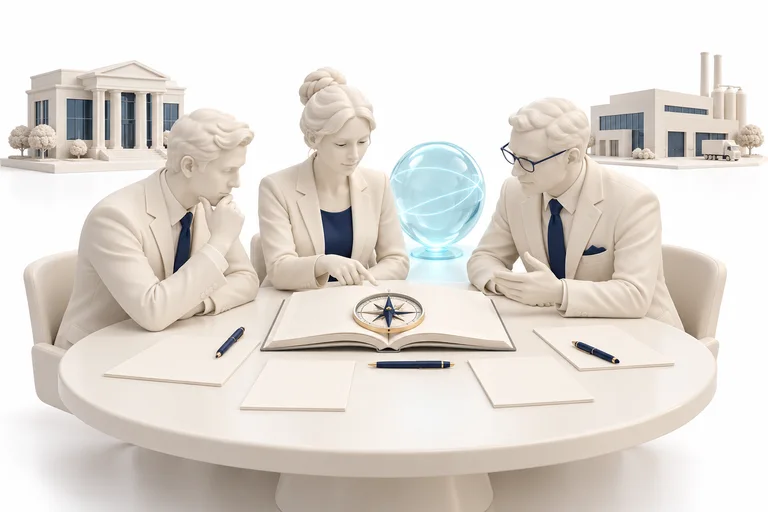
Concept illustration: a team combines organisational knowledge, direction and AI support.
People
Domain experts challenge the results and retain the decision.
Processes
The question, perspectives and quality criteria are clarified.
Technology
Suitable AI tools support analysis and the exploration of alternatives.

The intended result: Traceable decision inputs with options, assumptions and open questions.

Explore the entry Blueprint in detail

Concept illustrations, not product screenshots or customer photographs.

The learning organisation

Experience should travel further than the project.

AI can help structure knowledge, apply methods and prepare results. Sustainable learning requires more: people who verify, decide and improve the shared foundation.

We use AI in delivery, too.

For example, AI can structure approved source material, draft a process description or prepare test cases. We use the Blueprint to define the task and quality criteria. People review the output; your process owners and IT agree what can be adopted.

  1. 01

    Adapt

    Choose the scope, roles and permitted tools for your organisation.

  2. 02

    Apply & test

    Work on real cases. Review outcomes, exceptions and limits together.

  3. 03

    Capture learning

    Separate project-specific knowledge from potentially reusable lessons.

  4. 04

    Review & release

    Only approved, generalisable improvements enter a new Blueprint version.

The next version becomes the starting point for the next application.
Learning does not mean sharing everything.

Customer data and internal knowledge remain in the agreed context. Only authorised, generalisable insights may be reused. There is no automatic release and no autonomous transfer into other organisations.

Familiar building blocks. Connected differently.

The SMC foundation behind each plan.

Blueprints do not replace our methods. They connect them with a concrete implementation task. A framework gives direction, a method structures the work and a format brings people together.

Optional: see the SMC house and the three entry routes

Top-down starts with strategic direction; bottom-up starts with team learning; a lighthouse project starts with a concrete use case. These are complementary entry routes, not stages or separate Blueprint categories. A Blueprint can support any of them.
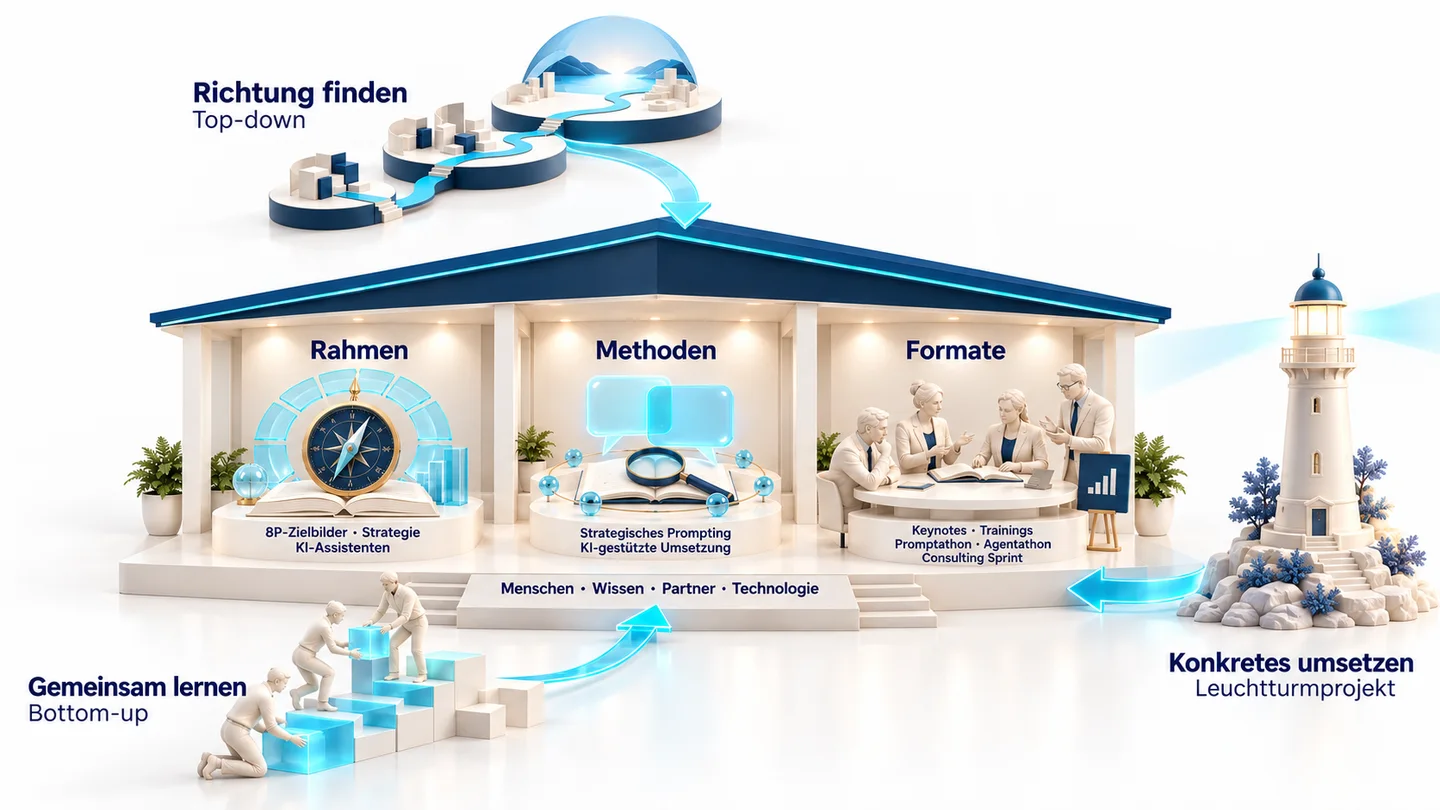
The SMC house connects frameworks, methods and collaboration formats. Direction, learning and implementation are complementary entry points.
Original illustration from the SMC company presentation (German labels). The three building blocks are explained in English below.
Framework

A shared direction

The 8P target pictures help teams consider the organisation from multiple perspectives.

Explore target pictures →
Method

Structured thinking with AI

Strategic prompting supports analysis, perspectives and the critical review of results.

Strategic Prompting →
Format

Learn by working together

Training, workshops and Promptathons give people space to practise on real tasks.

Explore learning formats →
Our next horizon

More organisations. Shared quality.

Our aim is to make suitable Blueprints usable with established partners, including partners already supporting small and medium-sized businesses. Close customer relationships and reusable SMC expertise can complement each other.

This capability is being developed. A Blueprint is only ready for transfer once its application, responsibilities and quality checks have been validated.

Discuss working together →
Start with a real challenge

Bring the task. We will find the starting point together.

We start by discussing the intended outcome, available knowledge and the people who need to be involved. Then we define a sensible scope.

Request an introductory conversation →

The introductory conversation is free. Individual company engagements are paid by prior agreement.

EVAAI
EVA · SMC knowledge assistant

Talk to EVA

Open full EVA Contact SMCPrivacy